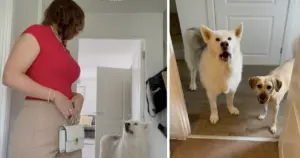
Hugo The Alaskan Malamute Appears To Ask His Owner A Question
Hugo’s Surprising Linguistic Ability
An Alaskan Malamute named Hugo has captured internet attention for producing vocalizations that resemble clear English speech. The dog approached his owner and made a distinct sound. Listeners interpreted the noise as the phrase where are you going. This moment was recorded on TikTok and quickly spread across social media platforms. The clip highlights an unusual instance of canine communication. It suggests a level of linguistic mimicry rarely seen in domestic pets.
Latest news
 Rescue Dog Shows Gratitude to Every Person Helping Her Heal
 Family Adopts Terminally Ill St. Bernard After Her Human Passes Away
 Neighbors Take Action After Town Ignores Abused Dog
 Retired Firefighter Reunited with Lost Dogs During Live Interview
Most dog owners rely on body language to interpret their pets' needs. Tail wags, ear positions, and barks convey emotion and intent. However, Hugo’s behavior defied standard expectations. Instead of a simple bark or whine, he produced syllables that sounded remarkably close to human words. The specific phrase he seemed to utter was directed at his human companion. This interaction implies a desire for verbal clarification rather than just physical expression. The video gained traction because it bridged the gap between animal instinct and learned vocal patterns. Viewers were fascinated by the clarity of the pronunciation.
Does Hugo Actually Understand The Words?
The phenomenon is not entirely new, but it remains rare. Some dogs learn to mimic sounds after hearing them frequently. Hugo may have picked up the phrase from his owner’s daily routine. Perhaps she often asks where he is going before leaving the house. Over time, the repetition allowed him to replicate the rhythm and tone. This process, known as vocal mimicry, requires significant auditory processing. It demonstrates that dogs can store and reproduce complex phonetic sequences when motivated.
# Can all Alaskan Malamutes speak English?
Understanding whether Hugo comprehends the meaning behind his sounds is difficult. He likely knows the context in which the phrase is used. If his owner leaves the room or prepares to go out, Hugo responds with this specific vocalization. This indicates associative learning. He connects the sound to a specific event or person. Whether he grasps the abstract concept of location is less certain. Most experts believe dogs respond to intonation and timing more than individual word definitions. Hugo’s performance, however, blurs these lines. It forces viewers to reconsider how much language dogs can absorb.
Social media reactions focused on the humor of the situation. Commenters joked about the dog’s concern for its owner’s whereabouts. Others debated if the audio was edited or enhanced. Regardless of technical adjustments, the core observation remains valid. Hugo produced a recognizable approximation of a common question. This incident joins a growing list of viral pet videos that challenge traditional views on animal intelligence. It reminds owners that their pets are constantly observing and learning from human habits.
# How did Hugo learn this specific phrase?
No, most dogs cannot produce recognizable human words. Hugo’s ability is exceptional and likely due to individual training or mimicry. Breed traits influence size and voice depth, but not necessarily linguistic skill.
# Is this proof of dog intelligence?
He likely heard his owner say where are you goingrepeatedly in similar contexts. Dogs are excellent pattern recognizers. They associate specific sounds with recurring events in their environment.
It demonstrates advanced auditory processing and memory. While it does not prove full language comprehension, it shows that dogs can store and reproduce complex vocal sequences accurately.